In today’s data-driven world, terms like mean and median are trending more than ever. People are searching for these terms to make sense of statistics in school, work, or even everyday life.
Knowing the difference between mean vs median helps you interpret data accurately, make better decisions, and understand trends in social media, finance, and research.
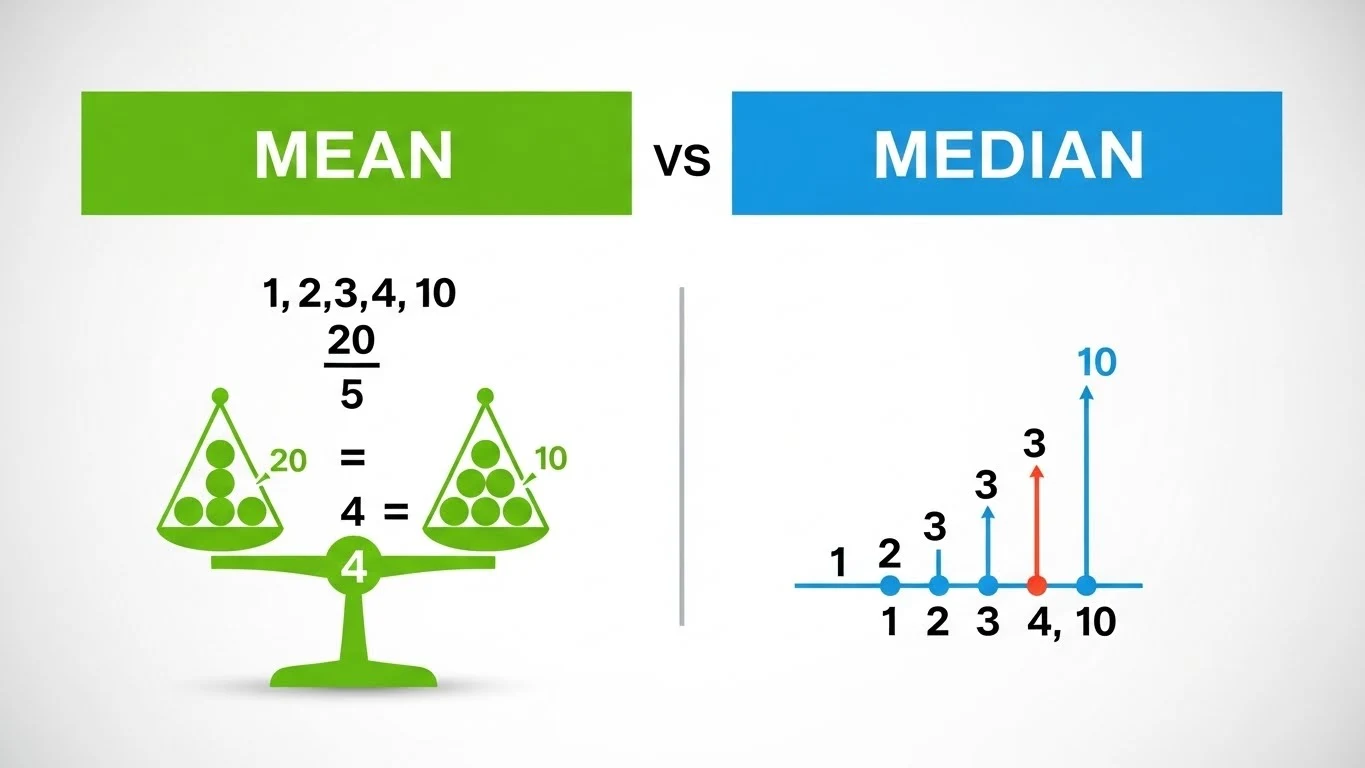
Mean vs Median are both measures of central tendency in statistics. The mean is the average of a set of numbers, while the median is the middle value when the numbers are arranged in order. Though they may seem similar, they tell very different stories about the same data.
⚡ Quick Answer
- Mean: The sum of all numbers divided by the total count.
- Median: The middle value in an ordered set of numbers.
Think of mean as the “overall average” and median as the “middle point” that separates the higher half from the lower half.
📚 Core Content Sections
In Texting and Messaging
In casual texting, you might see someone refer to mean or median jokingly to describe balance. For example:
- “That group chat is full of extremes; the median opinion is probably chill.”
Here, median highlights what most people feel, ignoring outliers.
In Love and Relationships
In dating or relationships, mean vs median can help explain trends in behavior or feelings:
- Mean: Average number of dates someone goes on per month.
- Median: The date count in the middle of all people’s experiences.
Median often gives a more realistic view, avoiding exaggeration caused by outliers.
In Slang and Casual Language
Sometimes, people use “mean” as an adjective meaning “harsh” or “impressive,” while median isn’t commonly used in slang. For example:
- “She’s mean at chess” = really good.
- “Median” mostly stays in math or formal conversation.
On Social Media Platforms
Platforms like TikTok, Instagram, and Snapchat often use mean vs median when discussing viral trends, salaries, or average followers:
- “The mean follower count is 10k, but the median is only 2k.”
This shows that a few big accounts skew the average, making median a better reflection of the typical user.
Spiritual or Symbolic Meaning
While not widely spiritual, some numerology enthusiasts look at numbers statistically, interpreting the median as balance and mean as harmony in a dataset.
Numerology or Cultural Meaning
Culturally, mean vs median is mainly educational. Some societies emphasize median values when analyzing wealth, income, or social trends because it reflects the “typical” person more accurately.
🧠 Examples & Usage
| Scenario | Data Set | Mean | Median | Notes |
| Test Scores | 50, 60, 70, 80, 100 | 72 | 70 | Median shows central tendency without being skewed by the 100. |
| Salaries | $30k, $35k, $40k, $150k, $200k | $91k | $40k | Mean is misleading due to very high earners; median reflects typical income. |
| Social Media Followers | 1k, 2k, 2k, 5k, 50k | 12k | 2k | Median better represents the majority of users. |
Example Usage in Text:
- “The mean score of the class was 75, but the median was 70.”
- “Median income is often more realistic than the mean, especially with outliers.”
Context Changes Meaning:
- Mean is best for evenly distributed data.
- Median is best for skewed data with outliers.
❓ Common Questions (FAQ)
1. What does mean vs median really mean?
- Mean is the average of all numbers. Median is the middle value in an ordered list.
2. Is mean or median positive or negative?
- Neither is inherently positive or negative; they’re just statistical measures.
3. Is median more reliable than mean?
- Yes, median is less affected by extreme values (outliers) and often shows a more typical trend.
4. How do I calculate them?
- Mean: Add all numbers → divide by total count.
- Median: Arrange numbers → pick the middle one (or average two middle numbers if even count).
🏁 Conclusion
In simple terms, mean vs median helps you understand data better. Mean gives the overall average, while median shows the middle point unaffected by extreme values.
By knowing both, you can interpret numbers more accurately, whether in school, work, or daily life. Now, you can confidently explain the difference to anyone!
